Viking Soda Bread

Ingredients
 
500g Plain flour
2 tsp bicarbonate of soda
1 tsp fine sea salt
400ml mix of natural yoghurt & milk


Optional: seeds to sprinkle on top

Method

1. Switch the oven on to 200°C/Gas Mark 6

2. Sift the flour into a large mixing bowl then add the bicarbonate of soda and salt. Make a well in the centre and add the yoghurt/milk mix. If adding seeds, do it at this point and mix well.

3. Tip out onto a floured surface and knead lightly for about a minute. Put onto a floured baking tray and mark a cross in the top.


4. Bake for about 40-45 minutes, to check it's done, turn it over and tap on the bottom - it should sound hollow.

5. For a crusty finish, cool on a wire rack. For a softer loaf, wrap in a clean tea towel.

Notes: This is a very simple way to make bread and incredibly forgiving - I've made it with nursery children with great success.  It works well for school sessions as there generally isn't the time to make bread that needs to rise.  The timings above are for a large loaf - I've found that with small rolls, hedgehogs or crocodiles (!) they don't need as long, maybe 15-20 mins.

How to...celebrate like a Viking

Putting the kettle on
Firstly, rummage through a box of fancy dress for Viking-style clothing - on the whole this was successful although I did quite want a horned helmet.

If you don't have a fancy dress box (and why wouldn't you?!) then old dark coloured towels, blankets, that sort of thing works well, piece of twine wrapped around the middle and, hey presto, instant Viking. 
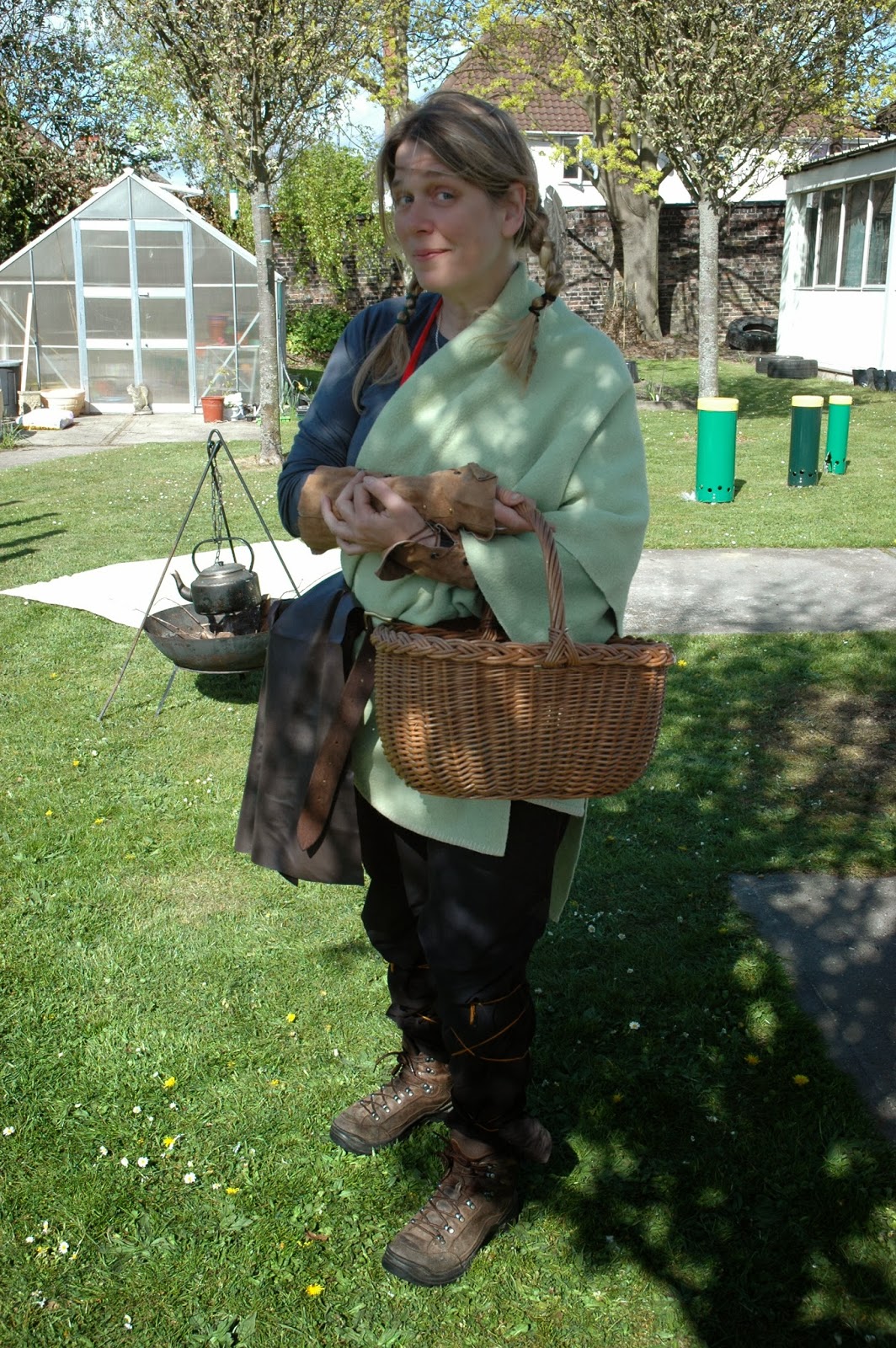


Mell gets her Viking on
Secondly, get a friend to help - I was lucky to work with Mell Harrison, from the Ringsfield Ecocentre Education Team, who is even happier than I am to dress up in the name of entertainment. She is also an expert in foraging, tracking and outdoor cooking to name a few of her talents.


Next, come up with some authentic-sounding Viking names; today we would be Helga and Ingrid. Then pick a Viking celebration day (of which there are quite a few); we settled for Sigrblot, which signified the coming of the warm season - obligingly the sun came out and made this feast day all the more glorious.


You also need to set up a banquet table; we used several large picnic tables.  Now, the more discerning of you will notice that there are at least two anomilies in the picture; one, Vikings didn't have teapots and teacups, however, I was fresh out of cow horn drinking vessels, and two, they probably didn't have tartan either. 

Get this party started: all we were missing were some rowdy Vikings
Add authentic food. No pineapple and cheese on sticks for these guys, party food for Vikings consisted of onions, leeks and cabbage...it kind of makes marauding through other people's towns and villages more understandable - quite possibly an attempt to improve their gas-inducing diet at home.

Rustic soda bread
I also made some soda bread and brought along some locally made honey (the bee man had been into the school on several occasions as part of the EastFeast Local Food project).


All set up, we were ready to invite the Vikings to help us celebrate - in this case, year 3 children from Roman Hill primary school.


After an introduction to Helga and Ingrid (at several points during the sessions I managed to forget which Viking I was, much to the children's amusement), we went aforaging through the small copse in the school grounds. Anything the children found of interest was added to the basket; nuts with holes in, leaves with strange colours, funny-looking sticks, you name it, we collected it.

Left, Mell goes through what is edible; middle, our spoils; right, mouse-nibbled cherry pips.
Clutching our full baskets, we emerged from the wood and looked at what we could and couldn't eat, identified some of the leaves and became nature detectives to see what might have had a nibble already.

Having established what we would eat safely, it was time to feast; whilst we tucked into soda bread with local honey, Ingrid (Mell) brewed two types tea; dandelion and nettle.  It was then that one of the Vikings asked if they could try the cabbage...upon declaring it was more than edible, the masses started munching on the raw leeks and even the onions! 

Roman Hill Primary's very own Viking clan
As the sun went down on our Sigrblot celebration, and our Vikings returned to their classrooms, pungent with the smell of raw onion and leek (apologies to teachers and parents), I couldn't help but be impressed by their enthusiasm and willingness to try vegetables that, quite reasonably, they may have turned their noses up to if served without the Viking backdrop. 

Part of what I love about this work is how each and every session changes, according to what the children are interested in. This, I feel, is where the real experience comes from and what makes the most of outdoor learning.  

This session was run by EastFeast, funded by Local Food, as part of the Waveney Food For Thought project.

If you are interested in having a Viking party at a school please contact me at phoebejwingate@gmail.com.

Creamy potato salad


Harvesting onions for the salad
Ingredients

Potatoes
Mayonnaise
Natural Yoghurt
onions
2 garlic cloves
Bunch of spring onions
Optional: Herbs such as chives or parsley

Method

1. Wash freshly harvested potatoes, spring onions and peel onions. 

2. Put potatoes in a large saucepan and cover with water. Bring to the boil and simmer for about 20 mins or until soft. 

Some of the ingredients and equipment used to make our salad
3. When cooled, cut potato into bite size pieces and put in a large bowl.  

4. Chop onion and add to the potato. In schools I find it helps to use an onion chopper (from pampered chef) as this helps reduce tears. Plus the children love using them.   

5. Grate garlic on the fine side of a mini cheese grater or crush into the potatoes. 

6. Use scissors to chop the spring onions into slices and add these too.

7. If using, snip some chives into the potatoes or rip up the parsley and add it. 

8. Add two large spoonfuls each of mayonnaise and natural yoghurt to the potatoes and mix well. Add more mayonnaise and yoghurt until perfect creaminess is achieved!
Right; the finished salad, totally prepared by the reception children

How to...Plant potatoes in buckets

Give your potatoes a head start by chitting them about 6 weeks before planting - that means they start growing shoots. 

The varieties I use with schools are first earlies in order to be ready before the summer holidays. Rocket and maris peer are quite good, but the best, in my humble opinion are Swift - a lovely potato that holds together once boiled and makes for a delicious potato salad!


Start chitting from the end of January.

Egg boxes are pretty handy to pop the potatoes in, then keep them somewhere light and cool, but nowhere they are likely to get frozen.


I use cut flower buckets from Morrisons to plant the potatoes in. They sell them at 8 for 99p, although more often than not I've been given them free, especially if I mention working with a school.

Put a few holes in the bottom for drainage.


After 6 weeks of chitting, get some multi-purpose compost, some children and stand well back whilst they break up the lumps.


Fill the bucket about a third of the way up. Gently put 2 or 3 chitted potatoes in the compost, being careful not to knock the sprouts off. Then cover with compost until the bucket is two thirds full.


If there is still the likelihood of frosts, wrap the bucket with fleece which is very cheap from most gardening centres. As soon it warms up the fleece can be removed.


When leaves are beginning to poke through the top of the compost, add some more to cover and fill the bucket to the top. This will encourage more potatoes to develop.


Potatoes need quite a lot of water, particularly when the weather is hot. Perhaps about half a large watering can per day or every other day. I was in this particular school every week so could oversee one watering session per week and we still had a good crop.

The more you look after them, the better the harvest.


Just before the summer holiday started, we harvested the potatoes. Much fun was had making soil sandcastles and then discovering the treasure!


The younger children enjoyed lining the potatoes up from smallest to largest. The older children had conducted an experiment to see what was better; planting 2 or 3 potatoes in a bucket.


We used our lovely potatoes to make two salads for the end of term celebratory picnic - two recipes I've used with great success are a creamy potato salad and a pesto potato salad.

FolkEast

Location: Great Glemham, Suffolk.
Project: Waveney Local Food for Thought

Summer is usually a quiet time for EastFeast. A time to sort out the tools, re-organise equipment and generally recuperate from what has been an amazing but incredibly full-on year. However, this summer we were lucky to be invited to have a stall at FolkEast, a small folk festival in it's second year of running, held on the Glemham Estate in South East Suffolk. With the promise of nasal singing, willow-wearing hat lovers and more ukeleles than you could shake a morris dancer's bells at, how could we refuse!

And so it was that last Thursday Mary and I packed our wellyboots, loaded our cars with materials and headed to Glemham. First challenge; site location...What's that you say? Between the main stage and the beer tent? By some gorgeous old oak trees?! Don't mind if we do! Done. Second challenge: construction of our new, very fancy gazebo, flags and table, courteousy of Local Food funding. Due to absence of instructions this took us slightly longer than site choice but our stall was beginning to take shape.


We settled on two activities for the weekend; labyrinth building and dreamcatcher weaving. As with all EastFeast work, we adapted a lot over the weekend. Originally we thought people could help build a labyrinth but actually this proved too fussy; having to sit and learn how to draw them was not what the majority of people wanted to do. Instead Mary and I layed out a very basic labyrinth that people could add to.


Friday and Saturday were all about the dreamcatchers. A steady stream of people of all ages came and had a go. We became particularly popular when the weather took a turn for the worse and our new gazebo was  incredibly efficient at protecting us from the elements. Every now and then we bailed out our smaller camp but by 6pm it was time to shut up shop and have a well earned beer (brewed by a local brewery especially for the festival). I had camped onsite the previous night but the dampness prevailed and I escaped home for a wash, clean socks and a dry night's sleep.

Feeling totally refreshed and ready for round 3, and spurred by brilliant sunshine, Mary and I returned on Sunday to a dry tent and prepared for what was the busiest day of the weekend. EastFeast Director, Yvoone Moores, joined us on Sunday, chatting to parents and getting contacts for further work opportunities.    

Enjoying the Sunday sunshine
Stone painting was particularly popular on Sunday and all sorts of gorgeous designs were added to the labyrinth, all to the background of Gypsy Fire playing on the main stage.

Just some of the gorgeous designs added to the labyrinth

A labyrinth, a strange character - it reminds me of the babe...
What really struck me was the diversity with which the activities appealled - over the course of 3 days I saw young children running round and around the labyrinth, teenagers engrossed in weaving, Dads totally absorbed in painting stones, slightly sozzled members of a wedding party (a 3 day event it seemed) working with willow and the man who sold sausage rolls getting excited about adding beads to his dreamcatcher.

And that's what makes this the best job in the world.

Naturally occurring: with no prompting whatsoever two young lads wrote this above the labyrinth.